Chapter 02
The CBRS Premium
Federal Designation & Permanent Scarcity
Summary: What the Federal Designation Actually Does
- Carova Beach sits entirely within the John H. Chafee Coastal Barrier Resources System. By law, no new federal expenditures or financial assistance may be made within this zone — a designation that does not expire.
- No NFIP flood insurance. No FHA, VA, USDA, or conventional conforming loans. No federal disaster assistance. No federal road or utility funding. These are permanent structural conditions, not temporary restrictions.
- The same federal law that raises your carrying cost permanently caps competing supply. 97% of CBRS units nationwide remained undeveloped since the 1982 designation — not by accident, but by design.
The single most important fact about Carova Beach real estate is not the price per square foot or the proximity to the ocean. Carova Beach sits entirely within the John H. Chafee Coastal Barrier Resources System (CBRS). By law, no new federal expenditures or financial assistance may be made within this zone — a designation that does not expire and can only be modified by an act of Congress.
Understanding what that means in practice is not optional for a serious buyer. It determines how you finance the purchase, how you insure it, what infrastructure you will and will not have access to, and why the market behaves the way it does. Every other variable in this brief — rental income, renovation costs, exit strategy — is downstream of this one federal designation.
What the Coastal Barrier Resources Act Actually Is
Congress passed the Coastal Barrier Resources Act (CBRA) in 1982, driven by two objectives: reducing federal expenditure on inherently hazardous coastal development and preserving the ecological function of barrier island systems. The mechanism was straightforward — designate specific undeveloped coastal areas as CBRS units and withdraw all federal financial assistance from those areas permanently.
The John H. Chafee Coastal Barrier Resources System, named for the late Rhode Island senator who championed the legislation, now encompasses more than 3.6 million acres of coastal land and associated aquatic habitat across the Atlantic and Gulf coasts, the Great Lakes, Puerto Rico, and the U.S. Virgin Islands. Carova Beach falls within one of the original 1982 units on the North Carolina Outer Banks.
The designation has no sunset clause. It does not expire with a new administration. Short of a specific act of Congress removing a unit from the system — which has occurred in limited cases under strict criteria — the CBRS boundary is permanent.
Carova Beach’s Official CBRS Designation
Carova Beach is confirmed within the Coastal Barrier Resources System under two officially designated Currituck County units maintained by the U.S. Fish & Wildlife Service:
CBRS Unit Designations
| Unit Number | Unit Name | County | Designation Type |
|---|---|---|---|
| L01 | Currituck Banks | Currituck, NC | System Unit (full CBRA restrictions apply) |
| L01P | Currituck Banks | Currituck, NC | Otherwise Protected Area (OPA — federal flood insurance prohibition applies) |
Residential properties in Carova Beach sit within Unit L01 — the full System Unit. This is the unit that drives every restriction detailed in this chapter: no NFIP flood insurance, no federally backed financing, no federal infrastructure funding, no federal disaster assistance, and no beach nourishment.
Unit L01P applies to the conservation and refuge lands that border the residential communities. Within an OPA, the primary CBRA restriction is the prohibition on federal flood insurance. Development and other federal assistance restrictions are more limited than in a standard System Unit.
Verify any specific parcel's CBRS status using the official U.S. Fish & Wildlife Service CBRS Mapper — the authoritative tool for parcel-level confirmation.
What CBRS Designation Actually Prohibits
What CBRS Designation Actually Prohibits
Federal financial assistance is broadly defined under CBRA as any form of loan, grant, guaranty, insurance, payment, rebate, or subsidy provided by a federal agency. For buyers, this translates directly and practically to:
CBRS Restrictions — Buyer Impact Summary
| Federal Restriction | Buyer Impact |
|---|---|
| No NFIP flood insurance (post-1982) | Eliminates FHA, VA, USDA, and most conventional loans |
| No federally backed mortgages | Cash, portfolio lender, or non-conforming only |
| No federal disaster assistance | Owner absorbs 100% of storm damage loss |
| No federal road or utility funding | No infrastructure expansion — by law, permanently |
| No federal beach nourishment | Erosion risk is unmitigated by any federal program |
- ×No National Flood Insurance Program (NFIP) coverage — properties in CBRS units that were undeveloped as of October 1982 are permanently ineligible for NFIP policies. This is not a temporary restriction or a processing delay. It is a structural exclusion with no workaround.
- ×No federally backed mortgages — FHA, VA, USDA, and conventional loans sold to Fannie Mae or Freddie Mac require NFIP flood insurance as a condition of financing in Special Flood Hazard Areas. Without NFIP eligibility, these loan products are unavailable for most Carova Beach properties.
- ×No federal disaster assistance for property damage — FEMA Individual Assistance programs that cover residential property repair after a declared disaster are unavailable within CBRS units.
- ×No federal funding for roads, utility infrastructure, or water systems — the absence of paved roads in Carova Beach is not an oversight or a funding gap waiting to be filled. It is a permanent condition of the federal designation. No federal dollars can be used to extend NC-12, install municipal water lines, or fund any other infrastructure improvement within the CBRS boundary.
- ×No federal beach nourishment or shoreline stabilization — the Army Corps of Engineers beach nourishment programs that have repeatedly rebuilt eroded shorelines in Nags Head, Kitty Hawk, and other Outer Banks communities are unavailable in Carova Beach. The shoreline here evolves on its own terms.
The Financing Constraint: What It Means in Practice
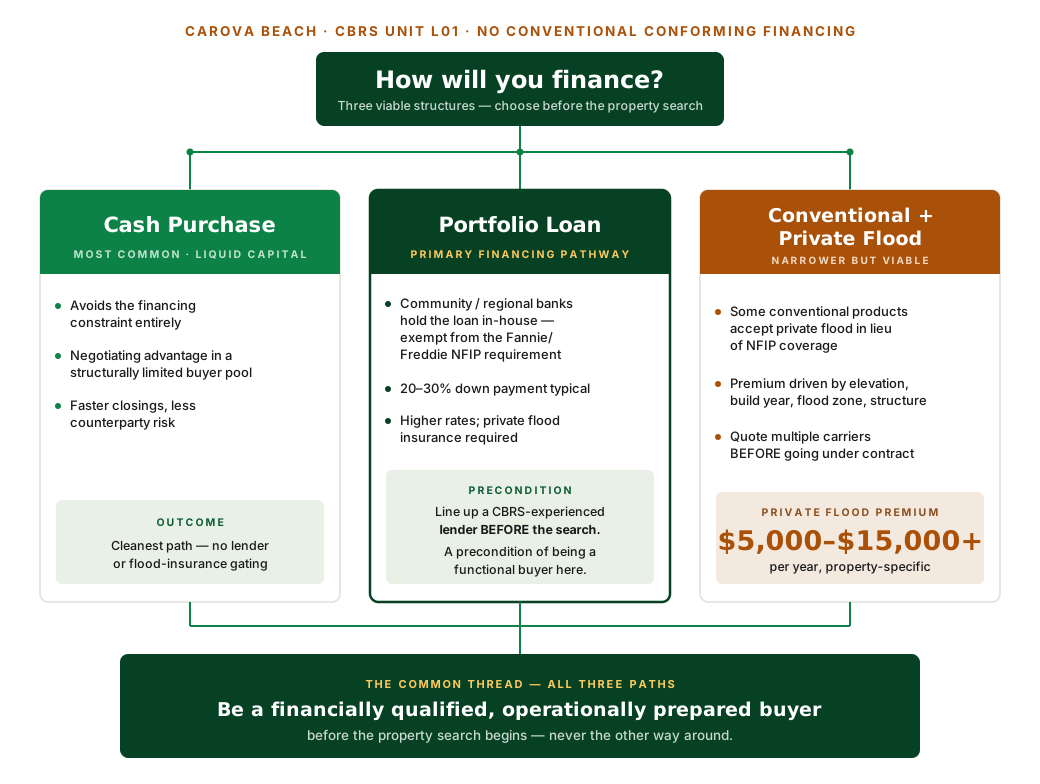
Because conventional financing is unavailable for the vast majority of Carova Beach transactions, deals typically fall into one of three structures:
Cash purchases are the most common. Buyers with liquid capital avoid the financing constraint entirely and gain a meaningful negotiating advantage in a market where the qualified buyer pool is structurally limited. Cash closings in Carova typically move faster and with less counterparty risk than in conventionally financed markets.
Portfolio loans from community banks and regional lenders represent the primary financing pathway for buyers who cannot or choose not to pay cash. Portfolio lenders hold the loan on their own balance sheet rather than selling it to the secondary market, which means they are not bound by Fannie Mae or Freddie Mac underwriting requirements — including the NFIP flood insurance mandate. Several lenders active in the Northeastern NC market have experience structuring portfolio loans for CBRS properties. Terms vary, but buyers should expect higher down payment requirements (typically 20–30%), higher interest rates than conforming loans, and lender-specific requirements around private flood insurance. Identifying a lender with demonstrated CBRS experience before beginning the property search is not optional — it is a precondition of being a functional buyer in this market.
Conventional loans with private flood insurance represent a narrower but viable path in specific circumstances. Some conventional loan products can accommodate private flood insurance in lieu of NFIP coverage, provided the private policy meets the lender’s coverage requirements. The private flood market for CBRS properties in Carova Beach is active but expensive — annual premiums of $5,000–$15,000+ are common depending on the property’s elevation, construction year, flood zone designation, and structure type. Buyers pursuing this path should obtain private flood insurance quotes from multiple carriers before going under contract, not during due diligence.
The practical implication of all three structures is the same: Carova Beach requires a financially qualified, operationally prepared buyer before the property search begins. This is not a market where you figure out the financing after you fall in love with a property.
How to Verify a Property’s CBRS Status
Not every property in the Carova Beach area carries identical CBRS exposure. The CBRS boundary is mapped at the unit level by the U.S. Fish & Wildlife Service, and specific parcels may sit within or adjacent to unit boundaries. Before writing an offer on any Carova Beach property, buyers should:
- ✓Confirm the property's specific CBRS unit designation using the USFWS CBRS Mapper — drop a pin on the specific parcel to generate official CBRS Mapper Documentation confirming whether that property is inside or outside the unit boundary. This is the parcel-level verification tool maintained by the federal government.
- ✓Cross-reference the CBRS unit boundary against the FEMA Flood Insurance Rate Map (FIRM) for the specific parcel.
- ✓Obtain a written statement from a private flood insurance carrier on insurability and premium range for the specific property prior to contract.
- ✓Confirm with a portfolio lender that the specific parcel is financeable under their CBRS loan guidelines.
The USFWS CBRS Mapper is the authoritative source for parcel-level determination — not the listing agent, not the county tax records, and not the MLS data field.
What a LOMA Can — and Cannot — Do in a CBRS Zone
Buyers researching Carova Beach will sometimes encounter references to a Letter of Map Amendment (LOMA) — a formal determination issued by FEMA that officially removes a property or structure from a designated Special Flood Hazard Area (SFHA) on the Flood Insurance Rate Map (FIRM). Understanding what a LOMA does, and critically what it does not do, is essential before drawing any conclusions about its relevance to a Carova Beach purchase.
A LOMA is an official amendment, by letter, to an effective NFIP map. It establishes a property’s location in relation to the Special Flood Hazard Area and is typically issued because a property has been inadvertently mapped as being in the floodplain, but is actually on natural high ground above the base flood elevation.
In practical terms: if a property’s lowest adjacent grade — the lowest ground point touching the structure — sits at or above the Base Flood Elevation (BFE) established for that area, the property owner can engage a licensed land surveyor or registered professional engineer to prepare an Elevation Certificate and submit a LOMA application to FEMA. FEMA will normally complete its review and issue its determination within 60 days of receiving a complete application. An expedited electronic process (eLOMA) is also available for qualifying properties and can return a determination within minutes — however, the eLOMA tool does not accept requests for structures located in a coastal flood hazard area (Zone V). Most oceanfront and near-oceanfront properties in Carova Beach are designated Zone VE, which means the standard paper-based or Online LOMC submission process applies.
The issuance of a LOMA eliminates the federal flood insurance purchase requirement as a condition of federal or federally backed financing. However, the mortgage lender retains the prerogative to require flood insurance as a condition of providing financing regardless of the location of the structure.
Here is where Carova Beach buyers must pay close attention:
A LOMA operates entirely within the NFIP and FEMA's flood mapping framework. It addresses one specific question: is this property correctly mapped within a Special Flood Hazard Area? It has no authority over, and no interaction with, the Coastal Barrier Resources System designation administered by the U.S. Fish & Wildlife Service.
A LOMA does not restore NFIP eligibility for a property in a CBRS zone.
If you live in a CBRS area, you are eligible for federally regulated flood insurance only if your property was built before 1982 and your community participates in the NFIP. That eligibility threshold is set by the Coastal Barrier Resources Act — not by the FEMA flood map. Obtaining a LOMA does not change when the property was built. It does not change the CBRS boundary. It does not remove the property from the CBRS unit. A Carova Beach property with a successfully issued LOMA is still in a CBRS zone, still ineligible for NFIP coverage under CBRA if built after 1982, and still requires private flood insurance for any buyer who needs flood coverage as a condition of financing.
When a LOMA is still relevant in this market
A LOMA has two legitimate uses for Carova Beach buyers, even given the CBRS constraint:
- ✓Private flood insurance underwriting. Private carriers underwriting flood risk in CBRS zones use the FEMA flood map designation as one input in their risk assessment. A property with a LOMA removing it from the SFHA — demonstrating that the structure sits above the Base Flood Elevation on natural grade — may attract more favorable underwriting terms and lower premiums from private carriers. The CBRS designation still prohibits NFIP coverage, but a LOMA can strengthen the private insurance picture by establishing documented elevation data in the official federal record.
- ✓Financing structure clarification. Portfolio lenders evaluating a CBRS property may weigh a LOMA favorably as part of their internal risk assessment, even though the lender retains the right to require flood insurance regardless of LOMA status. A LOMA provides documented FEMA confirmation that the property is not in the SFHA — a data point that can support the lender's underwriting on an asset that already sits outside conventional loan guidelines.
What a LOMA cannot do
- ×Remove a property from the CBRS system
- ×Restore NFIP flood insurance eligibility for a post-1982 structure in a CBRS unit
- ×Enable federally backed mortgage products (FHA, VA, USDA, Fannie/Freddie) for properties that are CBRS-ineligible
- ×Guarantee that a lender or private insurer will treat the property more favorably — both retain independent discretion regardless of LOMA status
The LOMA process if you pursue one
A LOMA application requires an Elevation Certificate prepared and certified by a licensed land surveyor or registered professional engineer. For Zone VE properties — the designation covering most oceanfront and near-oceanfront Carova Beach properties — the eLOMA tool is not available, and the application must be submitted through FEMA’s Online LOMC platform or via paper MT-1 form. Budget 60 days for FEMA’s review process. The Elevation Certificate requires a site visit and survey, so factor in the cost of the licensed professional along with FEMA’s review and processing fees.
If you are evaluating a specific Carova Beach property and considering whether a LOMA application is worth pursuing, the starting point is an Elevation Certificate from a licensed surveyor — that document establishes whether the property’s lowest adjacent grade clears the BFE, which determines whether a LOMA is even achievable before you invest time in the application.
FEMA LOMA Overview → FEMA LOMA Definition →
Private Flood Insurance: The Operational Reality
Private flood insurance for CBRS properties is available, but it is not a commodity product. Underwriting varies significantly by carrier, and coverage terms, exclusions, and premium structures differ materially from NFIP policies. Buyers should understand several things before entering the market:
Premiums are elevation-dependent. Properties with higher base flood elevations — particularly newer elevated construction built above the Base Flood Elevation — will consistently attract lower premiums than older, lower-elevation structures. This is a material variable in renovation and new build decisions: bringing a structure into CAMA compliance and elevating above BFE is not just a regulatory requirement, it directly reduces the annual insurance cost.
Coverage limits and exclusions matter. Private carriers may exclude certain types of flood events, cap contents coverage, or structure policies with higher deductibles than NFIP equivalents. A comprehensive review of policy language before binding coverage is non-negotiable.
Insurability is property-specific. A carrier who declines to insure one Carova Beach property may readily insure another three lots away. The underwriting is parcel-level. Do not assume that a neighbor’s insurable property means your target property is insurable on equivalent terms.
Policies may not be assumable by a future buyer. This affects your exit strategy. A well-documented, continuously insured property with a transferable or easily re-obtainable private flood policy is a meaningfully easier asset to sell than one with a gap in coverage history or an idiosyncratic carrier relationship.
The Development Cap as Long-Term Value Thesis
Every accessible stretch of North Carolina’s Outer Banks has experienced transformative development pressure over the past four decades. Corolla grew from a remote outpost to a dense vacation rental community. The towns of Duck, Southern Shores, Kitty Hawk, Kill Devil Hills, and Nags Head bear almost no resemblance to what they were in 1980. The forces that drove that transformation — federally subsidized flood insurance enabling lender confidence, federal infrastructure investment enabling development feasibility, NFIP backing enabling conventional financing at scale — are structurally absent in Carova Beach.
A 2007 U.S. Government Accountability Office report found that approximately 97% of all CBRS units nationwide had remained undeveloped since the original 1982 designation. That figure is not an accident. It is the direct result of removing the federal subsidy infrastructure that makes speculative coastal development economically viable.
In Carova Beach, the development cap is not a temporary condition or a political outcome that a future administration might reverse. It is embedded in the physical reality of the 4x4 access requirement and the federal law governing the CBRS boundary. The combination of the two means that the inventory of Carova Beach properties is fixed. It cannot meaningfully expand. New oceanfront product cannot be created at scale. The scarcity that defines this market today is the same scarcity that will define it in 20 years.
For buyers who understand this — and who can operate within the financing and insurance constraints the designation creates — the CBRS designation is not a liability. It is the single most durable source of long-term value in the asset class.
The CBRS Premium: A Summary
Conventional OBX vs. Carova Beach
| Factor | Conventional OBX Market | Carova Beach (CBRS Unit L01) |
|---|---|---|
| NFIP Flood Insurance | Available | Not available (post-1982 structures) |
| Federally backed financing | Available | Not available |
| Federal disaster assistance | Available | Not available |
| Future infrastructure expansion | Possible | Permanently prohibited |
| Development density ceiling | Market-driven | Federally capped |
| Buyer pool depth | Broad | Structurally constrained |
| Scarcity protection | Market-dependent | Legislatively permanent |
Sources