Chapter 04
Carova Beach Real Estate: Coastal Ecology & Wild Horses
Wild Horses, Protected Land & Living with the Natural System
Summary: The Ecology You're Buying Into
- The Currituck Outer Banks wild horse herd numbers roughly 100 horses managed by the Corolla Wild Horse Fund under a Currituck County ordinance. The 50-foot approach law is strictly enforced and carries real fines.
- Significant acreage north and adjacent to Carova Beach is protected federal land — Currituck National Wildlife Refuge — permanently removing it from development. This buffer is a long-term asset, not a liability.
- Carova Beach's ecology — dune systems, maritime shrub thicket, tidal wetlands, nesting shorebirds — is more intact than any other accessible stretch of the NC Outer Banks, and that integrity is legally protected and permanent.
The Ecology You're Buying Into
The wild horses, protected federal lands, and intact dune system of the Currituck Outer Banks are not amenities adjacent to the property — they are structural elements of the investment thesis. This chapter is about understanding what you're actually purchasing when you buy in Carova Beach: a position within an ecological system that federal law and market structure have rendered permanently scarce and legally protected.
The 50-foot horse ordinance, CAMA vegetation rules, and federal refuge boundaries are operational realities of ownership. Understanding them before closing is not optional — it is the baseline competency the market requires.
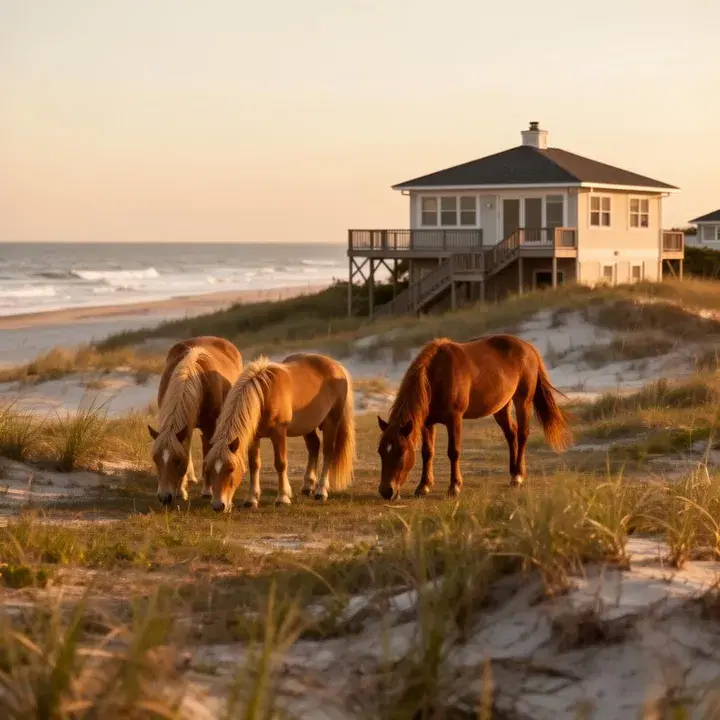
The wild horses are the image that stops the scroll. A herd of Colonial Spanish Mustangs crossing the beach at dawn in Carova Beach or Swan Beach — Currituck County’s 4WD coastal communities — ocean backdrop, no development visible. It is one of the most photographed wildlife scenes on the East Coast, and it appears in virtually every Carova Beach listing.
What the listing doesn’t tell you is that the horses are a legal and operational reality of property ownership — not a backdrop you observe from a distance. They cross driveways. They graze around structures. They block the beach corridor with no awareness of your schedule. Managing the relationship between your property and the herd is a routine ownership consideration in Carova Beach, governed by a county ordinance with real enforcement consequences.
The ecology chapter is about what you’re buying into — not just the horses, but the full natural system that the CBRS designation and federal land management have preserved north of the pavement end.
The Wild Horse Herd
The Corolla wild horses are not feral horses in the colloquial sense. They are descendants of Colonial Spanish Mustangs — horses that arrived on the Outer Banks in the 1500s, likely from Spanish exploratory voyages, and have lived on the barrier island system for over four hundred years. Genetic analysis has confirmed their Spanish Colonial heritage, distinguishing them from domesticated breeds and establishing their status as a nationally significant wild population.
The herd is currently managed by the Corolla Wild Horse Fund, a nonprofit organization operating under a management agreement with Currituck County. The current herd size is approximately 100 horses, a figure maintained through an active management protocol that includes fertility control to prevent population growth beyond what the available habitat can support.
The horses range freely across the 4x4 zone — on the beach, through residential areas, across undeveloped lots, and into private yards. They follow seasonal patterns dictated by food availability and water sources, but they are not predictable in the way that managed ranch horses are predictable. A stallion band may spend a week on your property, then not appear for two months.
The 50-Foot Ordinance
Currituck County Ordinance Chapter 10, Article IV establishes specific conduct requirements around the wild horses. The central requirement is a 50-foot minimum approach distance for humans — no feeding, no touching, no deliberate approach to within 50 feet. The ordinance applies to residents, visitors, and STR guests alike.
Wild Horse Ordinance: Key Provisions
Currituck County Chapter 10, Article IV — summary of enforcement-relevant rules
The ordinance applies to your guests. An STR operator whose guest feeds a wild horse faces the civil penalty, and repeat violations can affect operating permits. Include the 50-foot rule prominently in pre-arrival and in-property guest communication. The Corolla Wild Horse Fund provides downloadable materials specifically for vacation rental operators.
Landscaping and Property Considerations
The horses interact with private property. This has operational implications for property owners:
Fencing — Horses will push through or over inadequate fencing to access fresh water or vegetation. Traditional picket fencing or low post-and-rail is not horse-resistant. If you need to protect specific areas (gardens, HVAC units, ground-level mechanical), consult with contractors experienced in horse-aware design. Full property fencing is permitted but must allow horse passage in compliance with county and HOA restrictions where applicable.
Landscaping — Horses graze. Any ground-level planting they find palatable will be consumed. Dune-compatible native plantings (sea oats, wax myrtle, salt meadow cordgrass) are typically less appetizing than ornamental plantings and are the correct horticultural choice for this environment regardless of the horses.
Decks and exterior structures — Lower deck levels should be designed with awareness that horses approach structures. Ground-level HVAC, propane connections, and exposed mechanical should be protected or elevated.
Water sources — Remove standing water sources (buckets, pools, decorative ponds) that might attract horses to specific areas of the property if you prefer to discourage their presence on-site.
Protected Federal Lands
Carova Beach is bounded to the north and adjacent to significant federal land holdings managed by the U.S. Fish & Wildlife Service:
Currituck National Wildlife Refuge — Extends from just north of the Carova development area to the Virginia state line, encompassing the northern tip of the Currituck Outer Banks. The refuge protects approximately 4,000 acres of maritime grassland, shrub-scrub, forested wetland, and beach habitat. No development can occur within refuge boundaries.
North Carolina Estuarine Research Reserve components — Wetland and tidal areas adjacent to and surrounding the Carova development zone are protected under state and federal designation.
The practical consequence for property owners is significant: the buffer of permanently protected federal land to the north eliminates any future development pressure from that direction. There will be no subdivision carved out of the wildlife refuge. There will be no commercial development north of the existing Carova footprint. The view from a north-facing property in Carova Beach today is the view it will have in 50 years.
The Broader Ecosystem
Carova Beach sits within the Currituck Outer Banks ecosystem — one of the most ecologically intact barrier island systems remaining on the U.S. East Coast. The combination of CBRS designation, federal land management, and low development density has preserved habitats that have been eliminated across most of the Outer Banks.
Maritime grassland and shrub thicket — The interior of the barrier island, between the oceanfront dune system and the sound-side marsh edge, supports extensive native maritime shrub community — live oak, red cedar, wax myrtle, and yaupon holly — that provides habitat for migratory songbirds and year-round resident wildlife.
Dune systems — Active and semi-stabilized dune systems north of the development zone are among the best-preserved examples of Atlantic barrier dune ecology remaining. Sea oats and beach grass communities stabilize the primary dune ridge. These systems are what absorbs storm energy before it reaches structures.
Plant Types & Dune Stabilization
Native species serving ecological and structural roles in the Currituck Outer Banks dune system
CAMA Vegetation Rules: What Property Owners Must Know
Vegetation removal and landscape modification within CAMA-designated Areas of Environmental Concern (AECs) is regulated activity. Property owners who clear, grade, or alter vegetation within these zones without a permit face enforcement action and civil penalties — and violations attach to the land, not the prior owner.
- Sea oats are protected by state statute (NC G.S. 113A-202). Removal, cutting, or alteration without a permit carries civil penalties regardless of whether the plants are on your property.
- The oceanfront AEC extends from the first line of stable natural vegetation landward — clearing vegetation in this zone without a CAMA permit is a violation.
- The 30-foot coastal shoreline buffer restricts vegetation clearing adjacent to estuarine waters and public trust areas. Work within this buffer requires CAMA review.
- Landscaping within AECs — grading, clearing, installation of impervious surfaces, or removal of woody vegetation — triggers CAMA minor or major permit requirements depending on scope.
- Violations transfer with the deed. A buyer who inherits a property with unauthorized vegetation removal inherits the enforcement liability and potential removal orders.
Nesting shorebirds — American oystercatchers, Wilson’s plovers, and piping plovers nest on the beach corridor north of Carova during spring and early summer. Nesting areas are marked by the Corolla Wild Horse Fund and NC Wildlife Resources Commission during nesting season. The beach corridor in nesting areas is managed for minimum disturbance, which occasionally affects the northern extent of driveable beach during May and June.
Currituck Sound — The sound side of the barrier island provides critical habitat for migratory waterfowl, historically making the Currituck sound one of the premier waterfowl hunting destinations on the East Coast. This heritage — and the sound-side natural area — remains intact.
The Ecology Is the Investment Thesis
The intact natural system of Carova Beach — wild horses, protected dunes, federal land buffers, undisturbed maritime shrub communities — is not separate from the real estate value proposition. It is the value proposition.
Every parcel of land that remains in federal ownership north of the development zone is a permanent buffer against the forces that commoditized Corolla, Duck, and every other developed stretch of the Outer Banks. Every acre of wildlife refuge is real estate that will never become a vacation rental competitor or a commercial strip. The ecology and the investment thesis are the same thesis.
Buyers who understand this buy with intention. Buyers who treat the horses as a marketing backdrop and the federal lands as an afterthought miss the structural case for the asset they're acquiring.
Most Frequently Asked Questions, Answered
What do I do if a wild horse is on my property?
Nothing, typically. Horses on private property are legal and common. Observe the 50-foot rule from inside your structure if the horses are grazing nearby. Do not attempt to shoo them with vehicles, air horns, or physical contact — all of which constitute harassment under the county ordinance. If a horse is injured or appears in distress, contact the Corolla Wild Horse Fund emergency line. They are the authorized management organization and will respond.
Can I fence my property to keep horses out?
Yes, with appropriate construction. A horse-resistant perimeter fence is permitted. However, county and any recorded subdivision covenants may have height and material restrictions. Consult with a local contractor experienced in this specific context — standard residential fencing materials are not adequate for horse exclusion. The Corolla Wild Horse Fund does not manage horses' access to private property and cannot relocate horses from your lot.
How close is the Currituck National Wildlife Refuge to Carova Beach properties?
The southern boundary of the Currituck NWR begins approximately at the northern edge of the Carova Beach development zone. Properties in the northern sections of Carova Beach may directly abut refuge land to the north or have refuge land within visual range. This is generally a positive attribute — it creates a permanent open-space buffer — but it means that some northern-most lots face federal land access restrictions if the buyer intended to use adjacent areas. Confirm specific parcel adjacency to refuge boundaries during due diligence.
Are there any seasonal beach closures for wildlife in Carova?
Portions of the beach corridor north of Carova Beach may have seasonal access restrictions during shorebird nesting season (typically April through August). Nesting areas are marked with symbolic fencing. The restrictions apply to the area immediately around active nests, not to the broader beach corridor. Vehicle travel on the beach is still possible during nesting season — it may require detours around marked nesting plots in specific areas.
Do the wild horses affect property values?
Yes — positively, in the aggregate. The wild horse herd is a major driver of Carova Beach's national profile and a significant factor in STR desirability. Properties marketed as "wild horse territory" consistently command rental premiums. The horses are a marketing asset for vacation rentals, a quality-of-life asset for owners who value the natural environment, and a reputational factor that drives awareness of Carova Beach among buyers who would not otherwise encounter the market. The management overhead they create is real but considerably smaller than their value contribution.
Sources