
5 Wild Horse Rules for Carova Owners

In this post
You know it’s October on the 4x4 beaches when the north wind turns the surf gray and the beach lane goes from packed to pockmarked between one tide and the next.
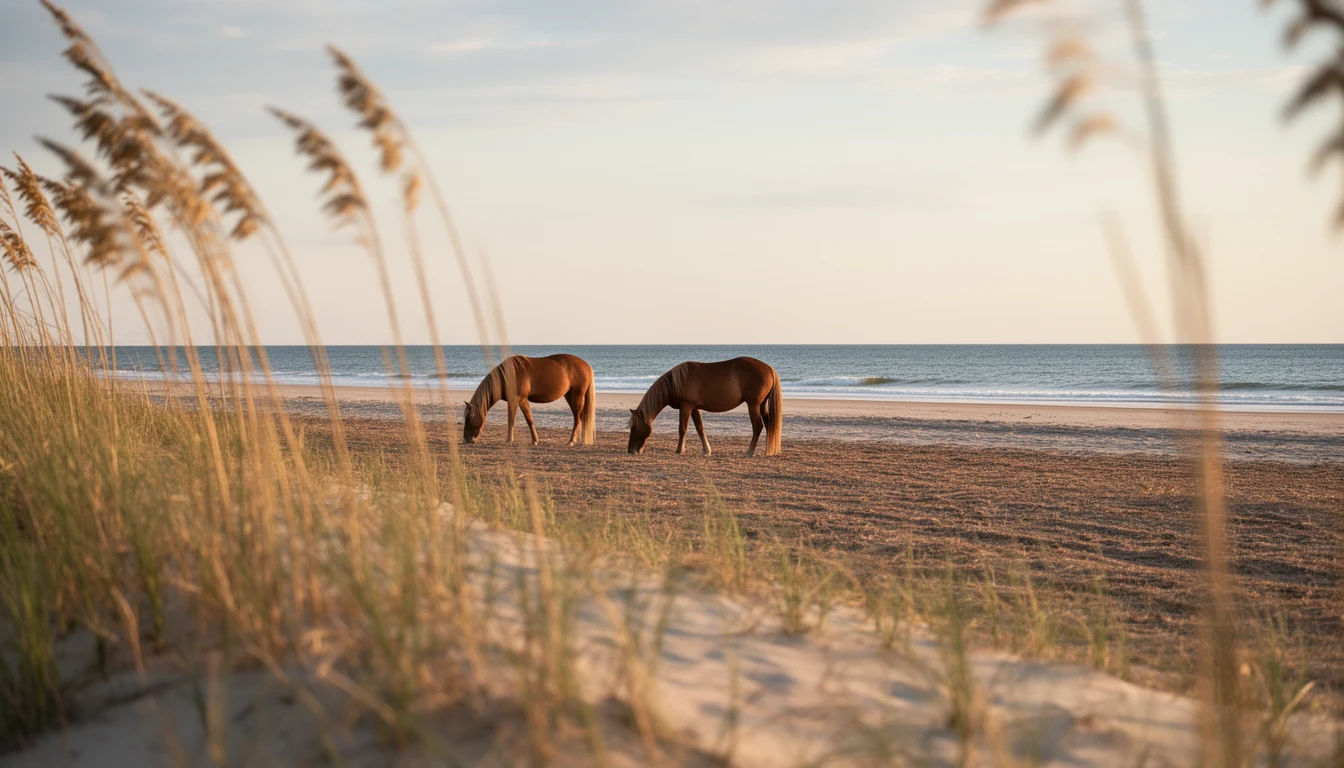
The horses read the season faster than we do. Coats come in thick, bands drift back toward the dry sand along the dunes, and the July traffic that made the beach drive a crawl is mostly gone.
That calm stretch is what people fall for out here. What they don’t always price in is the second thing that comes with the horses: a set of county rules that don’t take the winter off.
Those rules land hardest on property owners. You’re the one who hands the beach to guests all summer, and you’re the one the county calls when a guest does something dumb. Here are the five that matter most.
1. Fifty feet, on foot or in a vehicle
Currituck County’s wild horse ordinance is short and specific. By code it’s unlawful to lure or entice a wild horse to come within 50 feet of any person. It’s also unlawful for anyone other than an animal control officer, a law enforcement officer, a wild horse sanctuary officer, or a veterinarian treating a horse to intentionally come within 50 feet of one.
Fifty feet is about the length of a school bus. It travels with you: on the beach, in your driveway, standing on your own deck when a band wanders through the yard. The rule doesn’t care where your property line sits.
Practically, that means backing off before you reach for the phone camera. A telephoto lens or a phone zoom fills the frame from a legal distance, and the horses stay calm because nothing is walking at them.
2. No feeding, no riding, no petting, no luring
The county writes this as its own offense, and it’s the one visitors break first.
Nothing in a mustang’s gut is built for apples, carrots, bread, or whatever’s left on a picnic table. Colic from handouts is a slow and expensive way for a horse to die, and the horse never connects the food to the stomach ache.
So leave the cooler closed, and don’t leave a bucket or a bag out overnight. Out here that’s a handout too.
There’s a harder edge in the code as well. If you injure a horse, failing to notify the animal control officer or the sheriff’s department right away is itself unlawful. “I didn’t want to get in trouble” is not a defense the county recognizes.
3. Yield the beach, every time
The horses own the right of way, and the county enforces it from the driver’s seat too. Tour operators are licensed, and their rule is public: tour vehicles stay at least 50 feet off the horses, and a driving infraction or a license violation gets a citation.
Apply the same standard to your own truck.
Slow to a crawl the moment horses are in sight, even when they look a quarter mile up the beach. A foal can cross the sand lane in seconds. Never honk, never rev to move them, and never drive between a mare and her foal. If a band is standing in the lane, stop and wait them out.
Keep the windows up if a curious horse walks over. A friendly head in the window is one bite away from a bad afternoon.
Two housekeeping notes that go with the same permit: you need the county’s beach driving and parking permit on the vehicle, and your guests need it too when they take your truck up the beach.
4. No domestic horses north of the pavement
This is the rule almost nobody knows before they buy.
Currituck County’s code makes it unlawful to keep, harbor, maintain, possess, ride, walk, or bring a horse into the part of the Outer Banks that runs from the end of the paved NC-12 to the Virginia state line. That’s the whole 4x4 area, including your own lot.
So the horse trailer stays home. No trail riding on the beach, no boarding a horse behind the house, no pony rides for the grandkids on the sand. It looks like the most natural place in the world for a horse, and it is exactly the place the county decided a domestic horse can’t be.
The logic holds up once you’ve seen it: domestic horses mix with a wild herd in ways that go badly for the herd, from disease to herd dynamics to plain competition for the same forage.
If horses are part of your plan for a property, they need to be part of the conversation before you buy, not after.
5. Secure your trash the way the county wrote it
This one is pure owner housekeeping, and it comes with a fine.
In December 2023 the Board of Commissioners amended Sec. 11-29 of the county code to require enclosed, animal-resistant trash storage. Owners, occupants, tenants, and lessees who use commercial pickup have to keep roll-out carts in a four-sided enclosure, built within four feet of the right-of-way, made of wood, concrete, block, brick, or another material the building inspector approves, with ventilation and access for the hauler.
The ordinance gets specific: non-reflective black, brown, or green, resistant to rust and rot, bottom and sides sized so wind and animals can’t spill the contents, cans kept off the ground, and a cover over the top. The enclosure itself has to be either marketed by its manufacturer as animal proof, or approved as animal resistant by the Public Works Director.
There’s a workaround built in. A cart that meets the ordinance can sit curbside instead, as long as it goes out no earlier than 6:00 A.M. on pickup day and comes back off the curb by the end of that day. Put it out the night before and spill the contents more than once, and the county can require the enclosure anyway.
The penalty is a civil penalty of up to $500 per violation, and each day counts as its own offense. An enclosure left rotten or falling apart has to be removed.
The county’s own reasoning is the reason this rule exists: loose trash and flimsy cans pull wild horses into residential areas, and that contact ends badly on both sides more often than not.
When something goes wrong, make the call
Nobody plans to be the person who finds an injured horse. Out here you might be.
The rule is simple: report, don’t rescue. The Corolla Wild Horse Fund runs the herd under an agreement with Currituck County, and its office is on Corolla Village Road at 252-453-8002. Call the Fund when a horse is hurt, when a horse ends up somewhere it shouldn’t be, or when you watch somebody feeding or chasing one.
Do not walk up to a hurt horse, even a down one. A horse in pain is a thousand pounds of instinct, and you are not the exception.
One more county detail worth knowing if you ever have to report something: a violation can be established on the complaints of two or more people living at different addresses, or on the complaint of a single law enforcement officer. The code treats that as enough.
What the rules actually ask of you
Once you strip the language out, the deal is short. Keep your distance. Don’t feed them. Give them the lane. Don’t bring your own horse. Lock your trash.
The trade is real in both directions. You get a neighbor that wanders through your yard, grazes the landscaping you spent a spring on, and leaves evidence in the driveway. You also get a rental that sells an experience Corolla can’t match, and a back deck where the entertainment shows up on its own.
If that trade sounds like a bad deal, this beach will wear you down. If it sounds like the point, the rules are just the price of admission, and they’re cheap enough once you know them.
Learn them once, hand them to every guest in the welcome book, and the herd keeps being the reason you bought here.
Keep reading

Carova Emergency Care: Who Comes
Where emergency care actually comes from in Carova: a volunteer station inside the 4x4 zone, a beach-drive response, air medical, and the road to an ER.

6 Erosion Checks Before You Offer
Six erosion checks Carova oceanfront buyers should run before an offer: CAMA setback lines, dune vegetation, elevation certificates, and pilings.
Carova Contracts: Risks After Signing
A 2022 NC Supreme Court ruling confirmed buyers who breach a purchase contract can owe attorney's fees. What it means for Carova and Currituck County.